Zen Sailor-The Mindful Mariner ⚓
Field Log · Open Water
Zen Sailor
Navigating life's waters with maritime wisdom — dispatches from six laps around the world.
"Fear is for folks who don't get out much."
DescendTaking yourself with you
After spending eight months a year for the last ten years living out of a suitcase, it is easy to reflect on the value of thoughtful travel. I call it taking yourself with you. There is no such thing as work–life–vacation balance. Everything worth fighting for unbalances your life.
Travel, at its best, is creative destruction. In the wisdom of the moment, a new language, food, culture, and people are not problems to be solved but mysteries to be lived.
The whole exercise has to be one of reconciliation — lowering, removing, or shattering the walls of misunderstanding that unduly separate us, one human being from another.

The hunt for happy is the longing for repetition
The difference between hope and despair is a different way of telling our stories from the same facts. Pleasure is not happiness — but the joy I have pulled from a trip depends more on the mindset I travel with than on the destination I travel to.
Follow my example, not my advice
My daughter Truddie recently came back from Southeast Asia. Don't follow my advice, I told her — follow my example. She's doing just that. Already booked another trip with her husband Joe in May, for elsewhere.
My dream: I haven't been everywhere, but it is on my list. It reveals I never quite get over this travel-thing — it's all still in there somewhere. People make the experience vital. That's the mark of a good trip.
I never once heard a travel agent ask what we hoped to change about our lives, rather than simply where we wanted to go. Instead of bringing back three thousand refrigerator magnets, I return from my trips with a collection of small but life-enhancing thoughts.

We are not our stuff
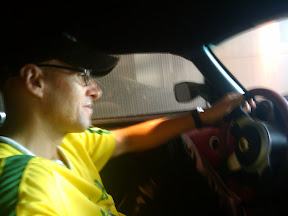
Empathy and sympathy — a big distinction
Empathy. I watch someone zoom past me in a tricked-out Ferrari — and he is not greedy or flashy but incredibly vulnerable and in need of love. I know, because I drove one in Monaco. I was that guy. At home we don't usually encounter our true and best selves.
Sympathy. I see bitterness — the silent disease of domestic relationships — take its toll. The habits and confinement of the ordinary commuter world. That resignation is like a spot on a shirt that never comes out. So don't just change your mind. Change your shirt.
The things you own end up owning you — but beds last longer than marriages.

Nostalgia — the suffering of an unappeased return
The Greek word for return is nostos. Algos means suffering. So nostalgia is the suffering caused by an unappeased yearning to return.
In Copenhagen I went for a bike ride through the center of the city. On one street lined with uniform apartment buildings, I stopped by a yellow building and felt an intense longing to spend the rest of my life there.
Born in New York — neurons that fire together, wire together. Considering how much inner nomad is in each of us, in adulthood I gave myself permission to leave as soon as possible, and to imaginatively re-create my ID in line with my true allegiances: a place noted for second chances, Venice Beach, California.
My vibe would create my tribe.

Life, based on a true story
My life, based on a true story, is downright paranormal. How the hell did I get here? Whatever talent I possess is on loan from some deity — some unimaginable source and force — for an exquisite portion of time, to be passed on when I am finished.
Fear is for folks who don't get out much. Outdoors is in.

The invention of the ship was also the invention of the shipwreck
The word blessing comes from the French blessure — a wound. So a blessing always has that other side to it. My cruising obsession is a private religion. It's where the bulk of my spirit is actually invested.
If I wanted to be a multinational soul, I needed to get consecrated by sailing the oceans. It is a wonderful thing to get rid of everything and everybody and go somewhere you know no one — where, as Melville said, God's one and only voice is Silence.
Those who do not move do not notice their chains. The Earth school kills all of its students. It only ends once; everything else is just progress. So do things that get you out of your default state and go to the edges — and profoundly do your human homework.

The zen of salt water
How inappropriate to call this planet Earth when it is quite clearly Ocean.
Six laps around the world does build confidence — trusting yourself. Only then can you begin to live. The whole secret is to have no fear. Never fear what will become of you; depend on no one.
The cure for anything is salt water — sweat, tears, or the sea. The sea is the place I house my soul and access my higher self.
