The Asymmetrical Life | A Five-Book Series
The Asymmetrical Life
The Asymmetrical Life is a series about making better decisions when the future refuses to cooperate.
Using poker, decision science, behavioral economics, and real-world experience, Ed Reif explores how to protect the downside, improve the odds, preserve optionality, and stay positioned for outsized upside.
These books are practical operating systems for uncertainty - built to help you think more clearly, risk more intelligently, and create a life where heads you win a lot, and tails you lose a little.
The Brief
Use the timeline to seek, or scan 15 seconds at a time.
Win Big and Only Lose a Little
Use the timeline to seek, or scan 15 seconds at a time.
One series. Five positions.
Across five books, the operating question keeps changing: Who are you when you stop performing? How do you think when luck refuses to cooperate? How do you design a bet when the future stays hidden?
How do you act before conditions are perfect? And how much power should uncertainty be allowed to take? Each book advances the problem: identity, probability, bet design, agency, then the architecture of uncertainty. The object changes state. The decision-maker changes with it.
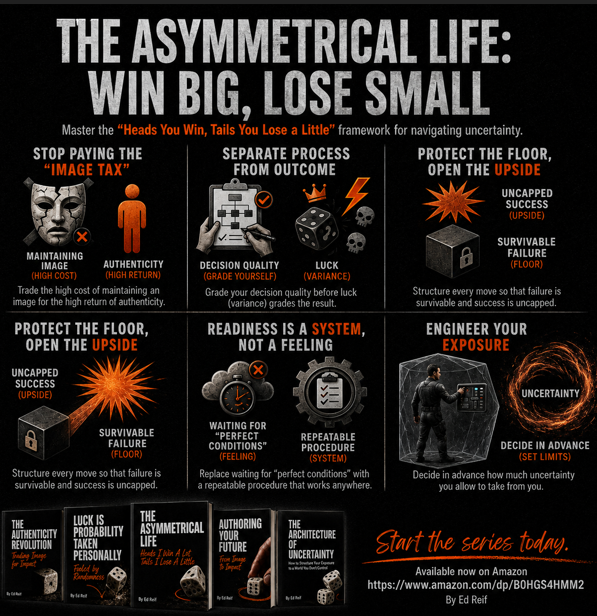
Identity → Probability → Bet Design → Agency → Exposure. Five books, one operating system: reduce fragility, improve decision quality, and keep the upside open.
Five books. One architecture.
Open any title below. Each book attacks a different layer of the same problem: how to act well when the outcome is not yours to command.
 Book 1 of 5
The Authenticity Revolution: Trading Image for Impact
The first asymmetric bet: stop paying the recurring cost of performance.
The Authenticity Revolution: Trading Image for Impact
The first asymmetric bet: stop paying the recurring cost of performance.
Maintaining an image is a recurring cost. You pay it in energy, in attention, in the small daily editing of yourself before you enter a room. Nobody sends you the invoice. You just notice, somewhere around the middle of your life, that the balance is gone.
Ed Reif paid that tax for years and thought he was winning. The posts landed. The presentations were flawless. The confidence never cracked. He should have felt successful. He felt like a fraud with good lighting.
What he found on the other side wasn't a healing story. It was an arithmetic problem.
Dropping the performance costs almost nothing. It is the cheapest move available to you - no capital, no credential, no permission required. And the return is uncapped. That is the definition of an asymmetric bet, and most people go their whole lives without noticing it sitting there in front of them.
The Authenticity Revolution is about the three positions that quietly drain the account: emotions you refuse to price, connections you approximate instead of make, and the running commentary in your own head that you'd never accept from anyone else. Each one feels like caution. Each one is leverage working against you.
This is not a book about fixing what's wrong with you. It argues something harder to accept: that the version of you underneath the presentation is not a liability to be managed. It's the only differentiated asset you own.
In these pages:
- Why the trait you've been hiding is usually the one with the highest return
- Defensiveness as a diagnostic instrument - it points at what you haven't dealt with
- Fear and excitement are the same signal in the body; the only difference is what you do next
- The VUE/VIEW framework for connection that doesn't require a script
- Why softening is not a retreat. It's the largest position you'll ever take.
You can keep paying the tax. Most people do, and most of them are competent, admired, and quietly done in by it.
Or you can stop, and find out what the world does with the actual person.
Trade your image for your impact.
 Book 2 of 5
Luck Is Probability Taken Personally: Fooled By Randomness
Separate decision quality from outcome quality.
Luck Is Probability Taken Personally: Fooled By Randomness
Separate decision quality from outcome quality.
No. It was a perfect decision with a painful outcome. Confusing the two is the most expensive mistake you will ever make - at the poker table, in the boardroom, and in life.
Ed Reif spent twenty years in high-consequence environments where decision quality was measured in outcomes far more serious than chips: teaching aviation English to Afghan Special Forces, designing training systems for autonomous maritime platforms, and sitting at poker tables where the same cognitive architecture that kept your ancestors alive will bankrupt you if left unexamined.
The operating question: can you learn to grade the decision before variance grades the outcome?
 Book 3 of 5
The Asymmetrical Life: Heads I Win A Lot. Tails I Lose A Little.
The central operating system for designing better bets.
The Asymmetrical Life: Heads I Win A Lot. Tails I Lose A Little.
The central operating system for designing better bets.
Most of us judge decisions by what happened afterward. We call a winning decision smart and a losing decision foolish.
But luck does not grade fairly.
The Asymmetrical Life is Ed Reif's practical operating system for making better decisions when the future remains hidden.
Drawing on poker rooms, career reinvention, travel, publishing, military training environments, a $100 car in Hawaii, Las Vegas, Macau, Hong Kong, and Bangkok, Reif explores a different way to think about risk:
Protect the floor.
Improve the odds.
Size the exposure.
Preserve optionality.
Leave the upside open.
The goal is not to become fearless, certain, or lucky.
It is to become harder to destroy through ordinary error - and better positioned for extraordinary outcomes when they arrive.
Poker is the simulator.
Life is the product.
 Book 4 of 5
Authoring Your Future: Shifting Your Agency
Turn readiness from a feeling into a repeatable system.
Authoring Your Future: Shifting Your Agency
Turn readiness from a feeling into a repeatable system.
Ed Reif spent twenty years building training systems for people who had to perform anyway - multinational teams in austere locations, requirements that changed mid-week, personnel who rotated out the day before the exercise. The work taught him something that transfers directly to a life: readiness is not a feeling. It's a system, and systems can be built by anyone willing to run them.
Most people wait. For the milestone, the clearance, the moment they finally feel ready. That wait is the single most expensive position you can hold, because the cost compounds quietly and the alternative is almost free. You do not need better circumstances to begin. You need a procedure you'll actually follow at 6 a.m. on a bad Tuesday.
This book gives you one. A personal SOP built on nine principles, with weekly drills that turn pain into data and data into a decision. It's for the high performer stuck in the next-milestone loop, the helper who's overfunctioning for everyone but themselves, and the operator who wants execution that stays calm when the week doesn't.
No permission required. No praise required. No perfect circumstances required.
 Book 5 of 5
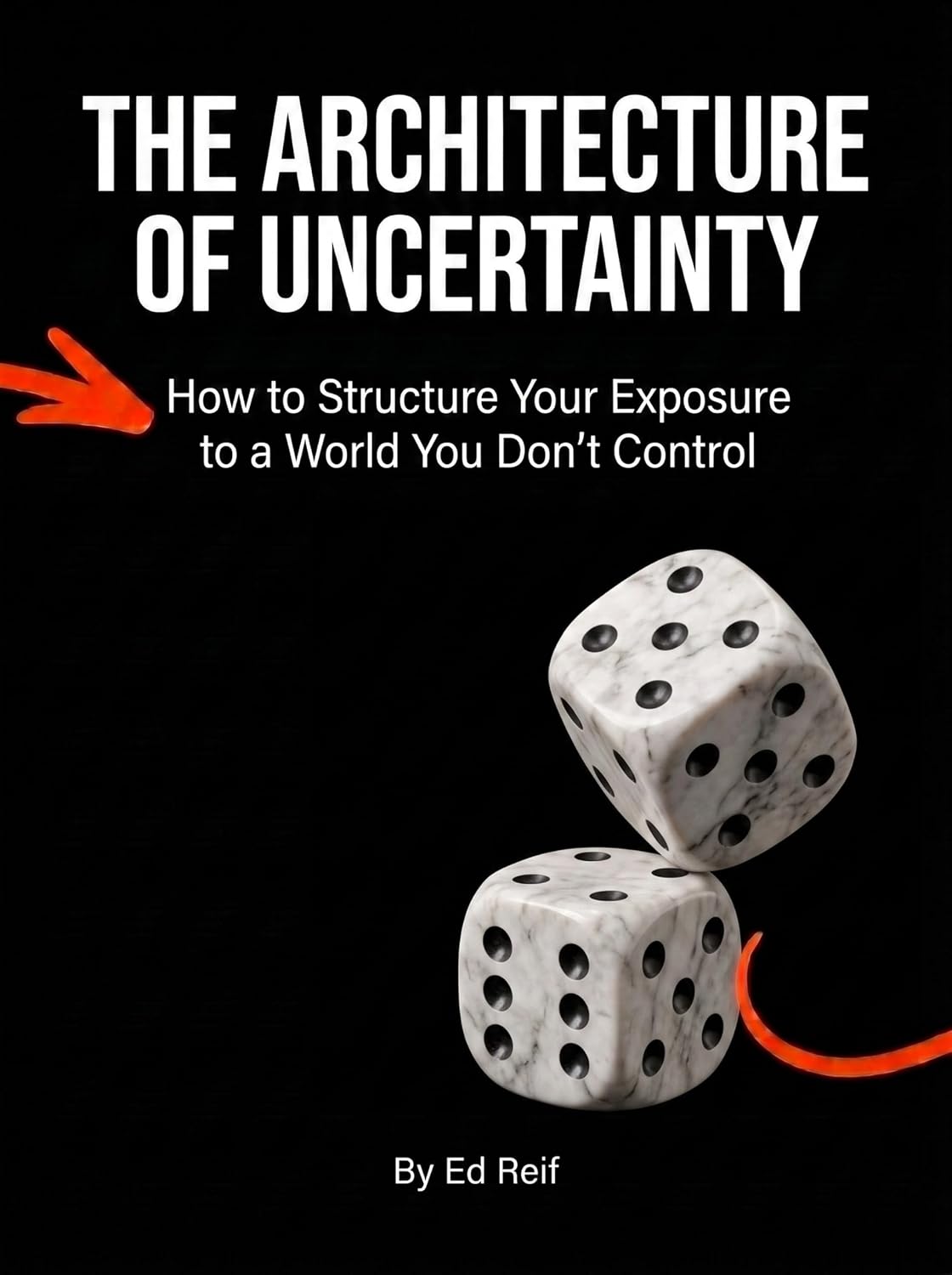
The Architecture of Uncertainty: How to Structure Your Exposure to a World You Don't Control
Agency as engineering: decide in advance how much uncertainty is allowed to take.
The Architecture of Uncertainty: How to Structure Your Exposure to a World You Don't Control
Agency as engineering: decide in advance how much uncertainty is allowed to take.
How to Structure Your Exposure to a World You Don't Control
An interpreter said that at Kabul airport, watching me argue with a schedule that had no interest in me. He was right. The airplane had not taken anything. I had handed it over.
Most advice about uncertainty tells you to think positively, predict better, or accept what you cannot change. This book does something harder. It treats agency as an engineering problem.
Drawing on twenty years in high-consequence environments - war-zone aviation training, FDA-regulated manufacturing, autonomous maritime systems, and several thousand hours at poker tables - Ed Reif builds a working architecture for deciding well when the outcome is not yours to command.
You will learn to draw the boundary between what you control, what you influence, and what you must simply price. To read a probabilistic world without taking variance personally. To choose which games deserve entry, protect the floor beneath which loss becomes ruin, size exposure from evidence rather than excitement, and know when to fold. To recognize the moment pressure stops accelerating your decisions and starts rewriting your rules. And to ask the question risk engineering usually skips: who pays if I am wrong?
The hinge is one sentence. An asymmetrical bet is a reserve clause with a position size attached. The Stoics knew you cannot command the outcome. They never built the structure that decides beforehand how much the outcome may take.
Twenty-five chapters. Six movements. Every one leaves a distinction, a decision rule, a protocol, or a field test - including the Control Boundary Matrix, the Six-Question Decision Audit, the Floor Test, the Exposure Card, the Asymmetry Test, the Downside Map, and the 404 Protocol for the moments when the plan stops loading.
This is not a book about becoming certain. It is a book about becoming capable.
From identity to uncertainty.
The five books can be read independently, but together they form a progression: reduce the hidden cost of performance, understand variance, design asymmetric bets, build agency, then engineer your exposure to what you cannot control.